
Fishing for Bass in Muddy Ponds After Rain: Best Lures & Tactics

You arrive at your favorite pond, gear in hand, only to find that last night’s storm has turned the crystal clear water into something that looks like chocolate milk.
Most anglers take one look at the water clarity, turn around, and go home.
But here is the secret most casual fishermen don’t know: Muddy water after a rainstorm can actually produce some of the best bass fishing of your life. You just have to change your tactics. When the water gets dirty, the bass don’t leave; they just change how they hunt.
If you are wondering how to tackle fishing for bass in muddy ponds after rain, this post breaks down the science, the location, and the specific lure selection you need to succeed when visibility is zero.
The Science: How Bass Hunt in Muddy Water
To catch bass in dirty water, you first have to understand their biology.
In clear water, a Largemouth Bass relies heavily on its sight. They can see a lure from 20 feet away and chase it down.
When the pond turns to mud, their visibility drops to zero. They can’t see more than a few inches in front of their face. When this happens, they switch their primary hunting sense from sight to their Lateral Line.
The Lateral Line is a sensory organ running down the side of the fish that detects vibration and pressure changes in the water. To catch bass in mud, you must stop worrying about how your lure looks and start worrying about how your lure feels* and *sounds*.
Where to Find Bass After a Rainstorm
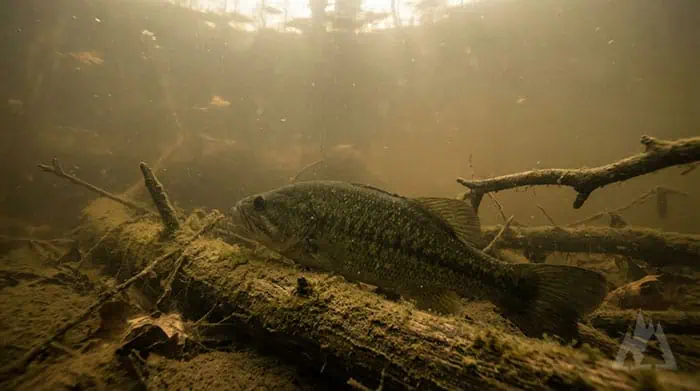
When a pond gets muddy, the bass behavior changes predictably. Here is where you should cast:
1. The Shallows (The Bank)
Muddy water acts as a “security blanket” for bass. In clear water, big bass stay deep to avoid predators (like birds or you). When the water is muddy, they feel safe roaming incredibly shallow water. Don’t be afraid to cast parallel to the bank in 1 to 2 feet of water.
2. Physical Cover (Wood and Rock)
Because bass can’t see well, they become “object-oriented.” They will hold tight to dock pilings, laydowns (fallen trees), and large rocks. They use these objects to orient themselves. You cannot fish open water in the mud; you must bang your lure against the cover to get a reaction.
3. Incoming Water (Inflows)
Look for where the rain runoff is entering the pond. It might seem counterintuitive to fish the muddiest part of the lake, but running water brings oxygen and bugs/worms into the pond. Bass will stack up at the mouth of a culvert or creek to ambush food washing in.
The Best Lure Colors for Muddy Water
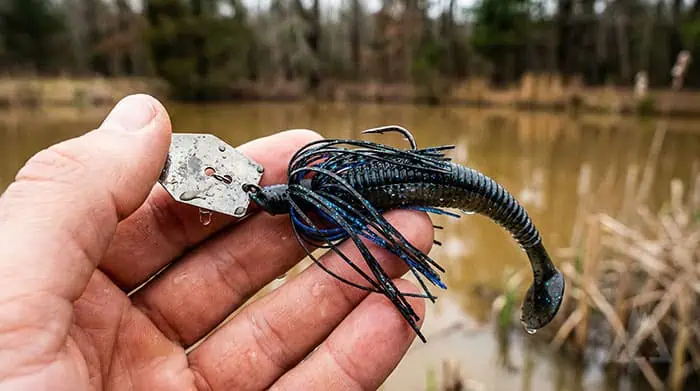
Leave your natural, translucent, and “ghost” shad colors in the tackle box. If the water is brown, your lure needs to offer maximum contrast.
Black and Blue: This is the #1 color combination for muddy water. It creates the strongest, darkest silhouette against the surface light.
Solid White: A solid white lure stands out well in stained water.
Chartreuse/Fire Tiger: Neon colors can sometimes trigger a reaction when natural colors disappear.
The Rule of Thumb: If you hold the lure underwater and you can’t see it, neither can the bass—unless it is vibrating.
Top 3 Lures for Muddy Ponds
1. The Chatterbait (Vibrating Jig)
If you can only choose one lure for muddy ponds, make it a Chatterbait with a dark trailer (Black/Blue). The metal blade on the front creates a violent vibration that bass can feel through their lateral line from several feet away. It allows the fish to “track” the bait without seeing it.
2. Spinnerbait with Colorado Blades
Spinnerbaits are classic, but the *blade type* matters.
Avoid: Willow blades (the long, skinny ones). These are for flash, which doesn’t work in mud.
Use: Colorado blades (the round, cup-shaped ones). These thump hard and displace a lot of water.
3. Squarebill Crankbait
A squarebill crankbait is designed to wobble aggressively. The “square” lip causes the lure to deflect erratically when it hits a rock or log. That deflection creates a pressure wave that triggers reaction strikes, even if the bass can’t see the lure clearly.
The Strategy for Success
Fishing for bass in muddy ponds after rain requires patience and precision. Remember these key takeaways:
1. Slow Down: The bass can’t see the bait coming. Retrieve your lure slower than usual to give them time to locate it.
2. Make Noise: Use lures that rattle, thump, or vibrate.
3. Target Cover: Cast repeatedly at logs and rocks. You might need to hit the fish on the nose to get a bite.
Don’t let the “chocolate milk” water scare you off. Tie on a black and blue chatterbait, head to the bank, and get ready for a fight. Tight lines!


